How to Tell an Encore from a Concert’s Final Song
Learn how to recognise a concert encore by listening for the departure, audience response and return that separate it from the set’s final song.
Has the band finished, or is this the pause before an encore? At a concert, the clearest clue is not how loudly the audience applauds but whether the performers leave after a clear ending and return for a distinct passage.
An encore is a way of framing extra music, not proof that a crowd has earned another song. The music may be planned in advance; what gives the moment its shape is the boundary between the set’s apparent close and what follows.
How can you recognise a concert encore?
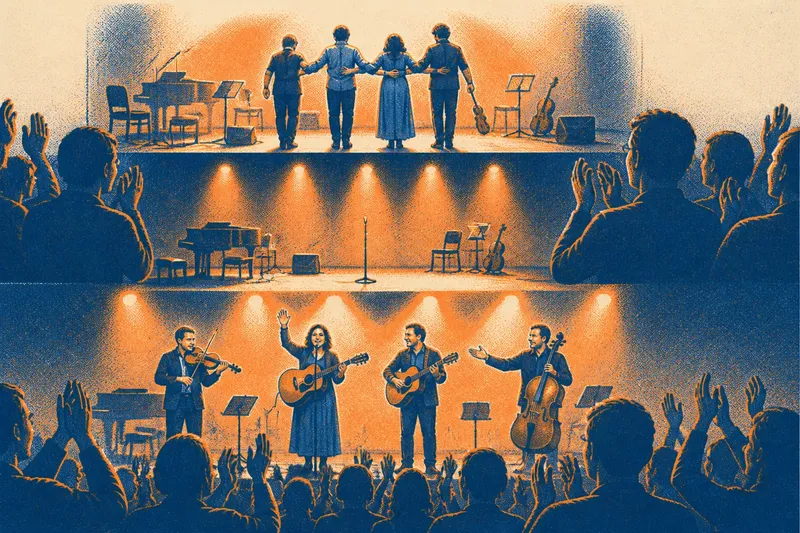
Look for a sequence: a clear close, the performers’ departure, a pause in which the room responds, and a return. The cues need not be elaborate. A bow, a goodbye, a lighting shift or a changed formation can help, but leaving and coming back do most of the work.
If the musicians finish one song and move straight into another without leaving, the added track is part of a continuous set. If they depart and reappear after applause, the show has framed the music as an encore, even if the return is brief.
An empty stage alone is not a promise. The audience may applaud because it was moved, while the performers may have finished for the night. Treat applause as appreciation rather than a contract.
Why does the departure matter?
Leaving the stage marks an apparent ending; the audience’s response fills the gap; the return answers that response. The pause makes the crowd’s presence audible and gives the extra music a different role from the songs that came before.
That exchange can be sincere even when the performers have chosen the encore in advance. The band may know what it plans to play, while the departure and return still create a distinct moment for the room.
There is no need to decide whether an encore is “real” by guessing what the musicians planned. Listen instead to how clearly the performance separates its main ending from the music that follows.
What should you listen for?
These cues help you understand the shape of the ending without treating any one of them as a rule:
- Was there a clear close? If a song ends fully and the performers bow or say goodbye, treat the departure as a likely boundary; if they leave between songs, it may be staging or a transition.
- Did the performers leave the stage? If they depart and later return, hear the next passage as an encore; if they stay in place, hear it as part of the set or an announced extra number.
- Did the audience have time to respond? If applause or calls gather during a pause, notice how the crowd becomes part of the exchange; if the band returns immediately, the moment may feel more like a planned transition.
- How does the return begin? If the musicians greet the crowd, change formation or start afresh, hear a newly framed passage; if they continue the previous musical flow, hear a closer link to the main set.
- What does the extra song do to the mood? If it offers a warm farewell or a striking contrast, notice that change as the encore’s final gesture; if it repeats the set’s existing mood, hear it as an extension rather than a new turn.
- How does the show end after the return? If the band gives a final farewell or leaves again, treat that as the completion of the ritual; if the performance ends without another cue, accept that as its stopping point.
Not every concert uses each cue, and no single gesture settles the question. The useful reading comes from the relationship between the apparent ending, the room’s response and the music that follows.
Which kind of ending fits the set?
A return can give extra music its own frame, while a direct ending can preserve the shape the set has already built. For listeners, the point is to notice what kind of ending the performers offer, not to rank one as more authentic.
- If the performers leave after a clear close: wait for a possible return, but do not assume one is promised.
- If the band stays onstage and announces another song: hear it as an extended set or direct finale, since there is no departure-and-return boundary.
- If the event follows a fixed programme: notice whether a planned return gives the extra music a distinct frame; if not, the performers can finish at the announced close.
- If the last song has already settled the mood: let a clean finish stand; if a contrasting return would add a new afterword, the encore can reopen the room’s attention.
- If applause continues after the band leaves: keep clapping if you wish, but accept that the performers may not return.
Say a small group ends with a quiet song, bows and leaves the stage. The audience applauds, and the group returns with a bright number; the contrast makes the return feel like a lively afterword. If the group instead stays to thank the crowd and leaves the quiet ending undisturbed, the observable result is a settled finish rather than a new burst of energy.
What questions help identify an encore?
Can an encore be planned in advance?
Yes. Performers can choose the extra songs beforehand and still frame them with a departure and return. Planning the music does not remove the distinct pause and re-entry.
Does an encore need more than one song?
No. One song can make a complete encore if the performance establishes a clear break and return. Several songs can also follow, but length alone does not distinguish an encore from a final section.
Is an announced final song an encore?
Not usually if the performers announce it and play without leaving the stage. It is more naturally heard as the finale or an extra number within the set, though concerts can blur that distinction.
Should the audience keep applauding?
Applaud to acknowledge the performance if you wish, but do not treat continued clapping as an obligation for the musicians to return. A clear ending deserves the same respect as an encore.
When is an encore not worth forcing?
A staged departure adds little if it interrupts an ending that already feels complete. There is no need to leave, wait through applause and return simply to make an ordinary final song seem more important.
If the set has reached a natural stopping point, a farewell from the stage can make that clear. An encore is most useful when the extra music has a distinct role—whether it offers a warm goodbye, changes the mood or gives the room one more shared passage.
When you hear a concert encore, follow the departure, the audience’s response and the return before judging the extra song. Those cues reveal whether the performance has opened a separate final passage or simply continued its set.