How a Setlist Makes Room for a Song’s Story
Learn how a setlist can frame a song’s story through lyrical echoes, contrasting meanings and well-timed returns, giving live performances a clearer narrative.
When a singer introduces a song about leaving home, the line can land differently if the set has already touched on departure or return. A setlist can make that connection deliberate: listen for lyrical echoes, shifts in viewpoint and the way a song’s meaning changes beside its neighbours. This is a different kind of pacing from simply alternating loud and quiet numbers.
How can a setlist create a story?
A live set does not need a plot with characters and a neat ending. It can create a looser narrative by placing songs in an order that lets one idea lead into another: longing into defiance, memory into acceptance, or a question into an answer.
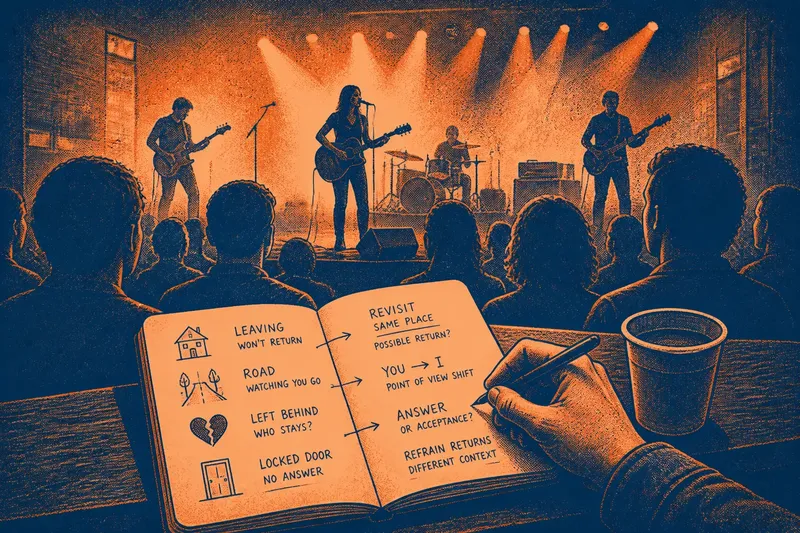
For a useful listening note, write down the subject or image that stands out in each song, then ask whether the next one repeats, challenges or develops it. Keep the observation grounded in words and performance details rather than claiming to know what the band intended.
What kinds of lyrical connections should you notice?
Look beyond repeated words. A set can link songs through related images, a shared speaker or a change in who seems to be addressed. A song about watching someone leave may sit meaningfully beside one sung from the perspective of the person who stayed.
- If two songs repeat a specific image, such as a road or a locked door, note where it appears; if the image changes meaning, describe the shift, and if it does not, record the recurrence without forcing an interpretation.
- If the singer moves from “I” to “you” or “we”, check whether the change alters the apparent point of view; if it does, name the shift, and if the wording is unclear, stick to the audible pronouns.
- If a later song appears to answer an earlier question, identify the relevant lines; if the connection is clear, describe it as an echo, and if it is only suggestive, mark it as a possibility rather than a fact.
- If a song’s subject breaks sharply from the surrounding material, note the contrast; if the contrast gives the set a new direction, describe that turn, and if no link is apparent, let the song stand alone.
- If spoken introductions add context, write down the specific information the performer gives; if it clarifies a lyric, connect the details, and if it does not, avoid using the introduction to infer a larger story.
- If a refrain returns later in the set, compare its delivery and surrounding material; if the changed placement alters its effect, explain how, and if it sounds unchanged, simply note the return.
How do placement and repetition change a song’s meaning?
A song may feel like a statement when it opens a set, but like a reply when it follows a track with a related lyric. Repeating a song later can also make its words seem different because the audience has heard more of the performance’s themes.
Say you hear a set begin with a song whose narrator insists they will not return, followed later by a track about revisiting a familiar place. You note the repeated idea of return, then check the lyrics and the singer’s spoken introduction for an explicit link. If none is offered, your account can say that the placement creates an audible echo, while leaving the band’s intention open.
What should you listen for in a set’s lyrical arc?
Can songs tell a story without being a concept album?
Yes. Shared images, changing points of view or a recurring question can create a loose arc without a continuous plot. Describe the connection you can hear rather than assigning characters or events the songs do not establish.
Should spoken introductions determine the interpretation?
They can provide useful context, especially when a performer names a place, person or event. Treat that information as one part of the performance, and distinguish it from meanings you infer from the lyrics.
How can you avoid overreading repeated words?
Record the exact word or image and where it occurs before deciding what it means. If the surrounding lines point in different directions, describe the recurrence without insisting that it carries one fixed message.
What is not worth the effort when tracing a set’s story?
It is not useful to invent a complete plot from a few similar phrases or to treat every song as a coded confession. Focus on clear lyrical details, placement and any context the performer actually provides.
To write about a setlist’s story, name the connecting detail and show how its placement changes what you hear. A repeated image, a shift in speaker or a later song that seems to answer an earlier one gives readers something specific to listen for, while careful wording leaves room for uncertainty.