A Quiet Concert, Heard on Its Own Terms
A quiet concert listening plan helps you follow phrasing, pauses and room sound, leaving you with clear details to remember without expecting a big climax.

A singer lowers the microphone after a line, and the guitar chord keeps ringing into the room. A quiet concert listening plan can help you notice how the sound ends, what the room adds, and how the next song begins. Rather than tracking every musical detail, follow how the performance meets the space and the audience.
How does the room shape a quiet concert?
Before the first song, notice the room’s ordinary sounds: ventilation, a door closing, or people settling into their seats. These give you a sense of the acoustic background, so a later pause does not have to mean complete silence to feel deliberate.
Listen for how a note changes as it reaches you. In a small room, a guitar chord may linger after the player’s hand has stopped; in a more absorbent space, its ending may feel abrupt. You do not need to identify the venue’s acoustic properties precisely. Describe the audible effect instead: the sound hangs, fades quickly, or blurs at the edges.
What does the audience add to the performance?
Audience behaviour can change the feel of a quiet passage. A held breath, a cough, or a shuffle may become noticeable when the band leaves space, but those sounds are not a verdict on the music. They are part of the conditions in which everyone is listening.
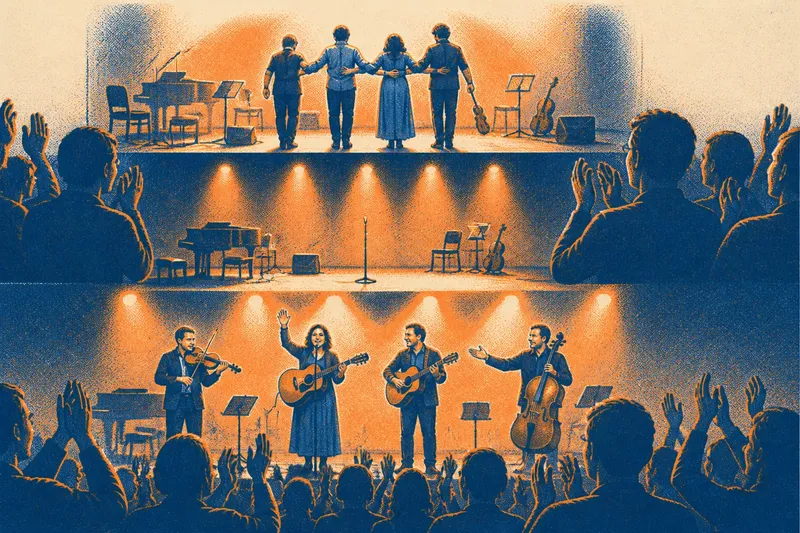
Notice when the room responds. Applause between songs may arrive quickly, while a pause after a final note can leave the ending exposed. The same silence can feel attentive or uncertain depending on what came before it; avoid assigning a motive to the crowd when you can record what you actually heard.
How can you remember the show without writing through it?
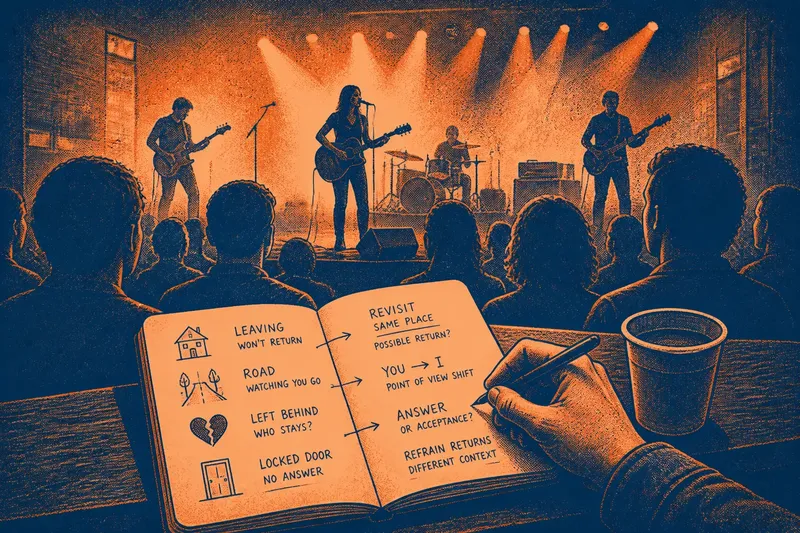
Use a short phrase as a memory cue during a break between songs: “voice alone at the end” or “chord rang into applause”. A few plain words can bring back a moment later without turning your attention away during the music.
Say you are at an invented acoustic set where the singer ends a verse, lets the guitar fade, and waits while the audience stays quiet. You write “long chord, no immediate applause” during the gap between songs. Afterwards, that note helps you recall how the room held the ending without claiming to know what every listener felt.
If you would rather not take notes, choose one moment to remember before you leave: a sound that lingered, an audience response, or a change in how close the singer seemed. A specific cue is more useful than a general judgement such as “beautiful” or “calm”.
What questions help you listen in a quiet room?
Should I move to find a quieter spot?
Usually, stay where you are unless the venue allows movement and you can change position without disturbing others. Chasing a clearer sound can draw attention away from the performance and disrupt people around you.
What if the room noise masks a moment?
Let it pass, then return to the sound in front of you. A missed detail does not prevent you from noticing how the next phrase, pause, or audience response changes the room’s mood.
How do I describe the room without technical terms?
Write what you hear: the voice sounds close, the chord trails off, or the applause fills the pause. Concrete descriptions are easier to remember than guesses about sound equipment or room design.
Is it useful to record the performance?
Follow the venue’s recording rules and the performer’s stated preferences. If recording is not permitted, a brief note between songs can preserve a memory without creating a distraction.
What is not worth the effort?
Do not try to catalogue every cough or decide what each silence means. It is enough to notice whether the audience noise interrupts a phrase, gathers after a song, or leaves a pause open.
Nor is it useful to judge a quiet performance by whether it reaches a loud climax. A room’s response, the decay of a chord, or the way a singer waits before speaking can give the evening its shape without a dramatic increase in volume.
How can you turn a listening cue into a clear memory?
Say you attend an invented set in a seated room. Your starting notes are simple: the singer performs alone with an acoustic guitar, the room has a faint ventilation hum, and the audience tends to applaud between songs. During one song, the singer ends a verse, lets a chord ring, and waits through a quiet pause before beginning again.
Write “chord fades; room stays quiet; singer restarts” during the next break. Later, you can describe the moment as an ending shaped by the lingering guitar and the audience’s silence. That account stays close to what happened in the room while leaving the listeners’ private reactions unknown.
The phrase quiet concert listening plan is most useful when it keeps your attention on what the room contributes, not when it turns listening into a record of every sound. One clear cue about an ending or audience response can preserve the character of a restrained performance.